|
Charleston, South Carolina THE AMBIENCE- HISTORIC HERITAGE Author: Barbara Hayo www.TrustedTours.com |

Ambience and History
 In Charleston you feel the history. Small in size and scale, tucked in among the
mysterious, fertile salt marsh of the Lowcountry, somewhat off the beaten path, it is a picturesque, genteel and historic jewel. Hundreds of splendidly
preserved historic structures, spared by Sherman during his march to the sea, rebuilt after natural disasters, and preserved through efforts of its citizens,
stand proudly along charming streets, giving Charleston a timeless quality and the appearance of time frozen.
In Charleston you feel the history. Small in size and scale, tucked in among the
mysterious, fertile salt marsh of the Lowcountry, somewhat off the beaten path, it is a picturesque, genteel and historic jewel. Hundreds of splendidly
preserved historic structures, spared by Sherman during his march to the sea, rebuilt after natural disasters, and preserved through efforts of its citizens,
stand proudly along charming streets, giving Charleston a timeless quality and the appearance of time frozen.
Amazing architecture is just one chapter in Charleston's spellbinding story. Uniquely influenced by its English, Barbadian and African heritage, this is a graceful city, charming to be in, a delight to explore. This historic seaport town is also worldly, shaped by the coming and going of people bringing goods and ideas "from away."
From the beginning, Charles Town was unique. Unlike the settlements in Virginia and New England, which were founded for political or religious reasons, Charles Town was established in 1670 by British adventurers with close ties to the West Indian island of Barbados, solely for the purpose of trade and commerce.
During the early years of the colony, products from the wilderness, beaver fur and deerskin, quickly followed by lumber and tar used in ship building, were traded. Next, planters began to grow rice and indigo on large tracts of land up the Ashley and Cooper Rivers, sending the products downriver to the growing port town for shipment by merchants. Sailing vessels from all parts of the globe lined Charles Town's busy docks and wharves, engaged in lucrative trade. Slaves were also openly traded along the wharves, as the success of the rice plantations was dependent on the use of slave labor, a practice and way of life brought to the colony by way of Barbados. The slaves not only provided the labor for rice cultivation, but the great success of "Carolina Gold," was attributable to the centuries old cultivation methods slaves brought from Africa.
During the 18th century, the wealthy port town of Charles Town was the major city in the southern half of North America. Planters grew what merchants shipped; merchants, in turn, brought in the fine goods that the people of Charles Town and surrounding plantations enjoyed and came to expect. Using acclaimed architects and the finest materials, the wealthy merchants and planters built extravagant residences in Charles Town and filled them with the finest appointments. Today, hundreds of these fabulously restored homes, testaments to the worldliness of the early residents, can be seen simply by walking along Charleston's charming streets. The range of historic homes is breathtaking; the architectural details astounding.
In addition to the English and the Barbadians, self-made men from France, Ireland, Scotland, and Germany, eager to attain wealth through the land and in trade, were drawn to the thriving community, becoming prosperous and further diversifying it. In tolerant Charles Town, its residents enjoyed the good life, living and entertaining in their opulent homes. Unrestricted by religious mores, there were lavish parties, dinners and balls; drink, cards, and horse racing; music, dance and theater, pastimes that began in colonial Charles Town and continued on into anti-bellum Charleston. As the most cosmopolitan city in America, it was the place to be seen, to entertain, and to show off wealth. Ladies dressed in imported silk; gentlemen sipped fine Madeira from Portugal.
Extraordinary wealth, close ties to Europe, and an environment of tolerance also positioned early Charles Town as the cultural center of colonial America. In the early part of the 18th century, the St. Cecilia Society was established to bring concert music to Charles Town, a tradition that remains today in the cultural offerings at the globally acclaimed Spoleto Festival USA , which draws thousands to Charleston every May. As early as 1736, professional traveling companies entertained with theatrical productions in the New Theatre on Dock Street Street, now the Dock Street Theater . Residents could borrow books from their public library, the first in America, established in 1743.

Wealth and the easy life were not all that shaped Charleston. This is a city whose graciousness masks the grit and determination of a people who endured many hardships. After suffering immensely during the Civil War, life and order as Charlestonians, both black and white, knew it, vanished. Slavery was abolished, the plantation economy changed, wealth was lost or re-distributed. It was not until the early 20 th century that the community began to recover from the ravages of a society turned upside down.
In the tumultuous times after the Civil War, it was determination, pride, and a deep respect for tradition that preserved Charleston's timeless beauty for future generations. Many of the nearly destitute former elite made ends meet by taking in any work they could, hanging on to their homes and vestiges of their former lives. Living in genteel poverty, "too poor to paint, too proud to whitewash," deteriorating homes were clung to and kept in the family. This same sense of pride in place led Charlestonians in 1931 to become the first city in America to pass a preservation ordinance protecting entire neighborhoods, not just individual places, thus ensuring Charleston's place in history. Her city seal sums it simply: "She guards her buildings, customs and laws."
Of equal importance to the uniqueness of Charleston is the influence of African culture and the culture of the slave experience. It permeates everything in the Lowcountry - agricultural methods, decorative architectural elements, music, food. While huge numbers of slaves were plantation field hands, in Charleston they were blacksmiths, carpenters, masons, shipbuilders, seamstresses, tailors and bakers. Through a complicated registration system, these skilled slaves were hired out, becoming indispensable to city life, and able to move freely about town as long as they wore a "badge," a tag made of copper and stamped with their skills. Following the civil war, Charleston was a magnet to many of the 400,000 slaves freed in South Carolina alone, creating a city more black than white, further influencing the culture of Charleston.
Today, people from all over the globe are drawn to the magic that is Charleston. They come, eager to soak in the unique and timeless ambience and to take in the visual delights. A walk through historic Charleston is one of joyous discovery: Barbadian "single" houses in rainbow colors with piazza's to catch the breeze; porch ceilings painted the "haint" blue of Gullah superstition; formal English gardens hidden beyond the delicate filigree of wrought iron gates, first crafted by skilled slave blacksmiths; carved pineapples on entrance gates, a sign of welcome in the tradition established by sea captains signaling their return; classic columns in a progression of orders gracing entrances of former town homes of gentlemen planters; church steeples rising in architectural contrast above the low-scale skyline, reminders of the city's acceptance of diversity.
Charleston is the sound of white tabby walkways, crunching underfoot, remnants from the nearby fertile oyster beds; the burnt look of Charleston gray brick, the color of the land; the statement made by Charleston's signature green shutters - 2 parts "Yankee" black and 1 part "rebel" yellow. It is a city whose soft sea air is permeated with the sensuous fragrances of jasmine, laced with the soft sounds of Gullah, and filled with the aroma of wonderful Lowcountry cooking, created in part from the bounty of the surrounding sea - oysters, she-crabs, shrimp; in part from the productive land - okra, hominy grits, black-eyed peas and collard greens.
Charleston is staying in an antique-filled Bed & Breakfast, where breakfast is served on a silver tray. It's discovering gardens hidden behind entrances elegantly framed in fragrant jasmine and draped in the cascading purple of wisteria. With more restaurants per capita than any city in America, it's a foodie's delight of menus laced with savory Lowcountry ingredients served in lovely settings - roasted red snapper with Lowcountry succotash and shrimp at Anson, she-crab soup at 82 Queen, brunch on blackened shrimp and scallops with grit cakes in the Barbados Room, heavenly praline soufflé at High Cotton.
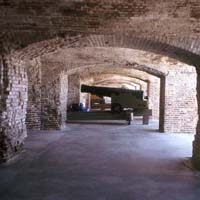
Browse for antiques along King Street, find traditional sweet grass baskets at City Market , climb through historic Fort Sumter, where the first shot of the Civil War was fired. Walk down Church Street , where St. Philips Church , in the English way, juts out into the brick roadway, and down cobblestone Chalmers Street, to the Pink House , the oldest masonry house in Charleston, built in 1690. See the city on a leisurely horse-drawn carriage ride. Admire the "free-flying" staircase and period furniture at the Nathaniel Russell House; see the only historic 18th century kitchen open to the public in the Heyward-Washington House (1772); glimpse the opulent life-style of a wealthy rice planter in the Joseph Manigault House (1803); stroll past the elegant homes along the Battery; linger awhile on a battery bench in White Point Gardens.
Drive out Ashley River Road to experience 18 th century plantations. Watch actors demonstrate the skills of slave artisans on the plantation at Middleton Place. Spend an afternoon surrounded by the sheer beauty of Magnolia Plantation & Gardens , where there is always something glorious blooming. See the most significant Georgian Palladian home in America, Drayton Hall, a plantation house remarkably intact and unchanged since 1738, retained in the Drayton family until 1974, when ownership was transferred to the National Trust for Historic Preservation.
Treat yourself to Charleston - its architecture, culinary delights, sumptuous lodging, and gracious demeanor, layered in history and veiled, ever so lightly, in mystery.

Trust us, we've been there!
www.trustedtours.com