|
Charleston, South Carolina MUST DO's Author: Barbara Hayo www.TrustedTours.com |


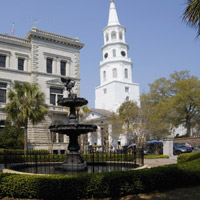 • Discover historic Charleston on foot. Put on your walking
shoes, and with map in hand (along with one of several walking tour books or a book on Charleston architecture), follow your own path! You'll delight in your
discoveries! The number of meticulously restored and maintained historic buildings and delightful garden spaces draped in color is astounding. Adding to the
charm of Charleston, residents and businesses live side by side in these wonderful buildings, many once-private mansions, and it is not always clear which are
residences, which are businesses, and which are historic sites. There is no other city quite like it.
• Discover historic Charleston on foot. Put on your walking
shoes, and with map in hand (along with one of several walking tour books or a book on Charleston architecture), follow your own path! You'll delight in your
discoveries! The number of meticulously restored and maintained historic buildings and delightful garden spaces draped in color is astounding. Adding to the
charm of Charleston, residents and businesses live side by side in these wonderful buildings, many once-private mansions, and it is not always clear which are
residences, which are businesses, and which are historic sites. There is no other city quite like it.
• Tour a house museum. While most of Charleston's vast collection of historic Buildings - 73 pre-Revolutionary War, 136 late 18th century, and over 600 pre-dating 1840 - are privately owned and not open to the public, those that are provide a real feel for life in Charleston from the before the Revolution to the Civil War.
- Heyward Washington House (1772) George Washington stayed here in 1791 on his presidential grand tour of the country. Built by the "Rice King," the wealthy rice planter father of Thomas Heyward, Jr., a signer of the Declaration of Independence, it is filled with fine period furniture, much of it made in Charleston. On mantels and cabinets, look for designs of the figure 8 with 4 diamonds, signature carvings of Thomas Elfe, one of America's best cabinetmakers. The 18th century kitchen behind the house is the only historic kitchen open to the public.
- Joseph Manigault House (1803) Lovely in the delicate Adams Federal style popular after the American Revolution, it exhibits the worldly sophistication of its original owner and many early Charlestonians. The curving central staircase is remarkable, as is the outstanding collection of period furnishings. The rice plants carvings in the bedposts on the mahogany beds reveal the importance of "Carolina Gold" in the wealth of the planter community in which the Manigaults were important players.
- Nathaniel Russell House (1808) One of America's finest examples of the Adams architecture, it was built by Nathaniel Russell, the richest merchant in the Post-Revolutionary period. Its most famous feature is a free-flying staircase, spiraling upwards, seemingly unsupported, for 3 floors. The main rooms are notable for having different geometric shapes, square, rectangular an oval, and the gardens, initially planted under the direction of Russell's wife and daughters, are lovely.
- Aiken-Rhett House (1817) Astoundingly unique in that it has been preserved, not restored, looking as it did in 1858, thereby providing an unvarnished insight into pre-civil war town life. The outbuildings behind the house - slave quarters over the kitchen, privies, and stables, offer a simple statement of the realities of life during that era.
- Edmonston-Alston House (1825) Built on the High Battery by a wealthy merchant overlooking his interests in the harbor, the elegant Greek Revival home has original heirloom furnishings, wonderful silver pieces, family portraits and, quite remarkably, Charles Alston's nearly intact library.
- Calhoun Mansion (1876) Constructed during the dark days of post Civil War Charleston, when very few mansions were built, the Victoria-era excess of this enormous, exquisitely appointed 24,000 square foot house just off the Battery is a rare sight.
• Go antiquing. Not just for the serious collector, but fascinating for the novice too. Unique circumstances combine to make Charleston a center for fine antiques. Fine furnishings from England and the Continent, amassed by wealthy merchants and planters throughout the 1700s through the mid 1800s, found their way into auction houses in the aftermath of the Civil War. As families were forced to sell their belongings to survive, dealers from the northeast cities flocked to Charleston to buy them. Today, the tradition of Charleston as a treasure trove of fine antiques continues in the stores along King Street, with many concentrated in the Antique District, between Queen and Beaufin. Today, pieces come primarily from auctions, estate sales, or imports from other countries
• Visit the early Ashley River plantations. No visit to Charleston would be complete without seeing the land along the river, the genesis of Charleston's fabulous wealth. Drive out Ashley River Road, under the canopy of ancient oaks to Drayton Hall, Magnolia Plantation and Gardens and Middleton Place, all pre-dating the Revolutionary War.
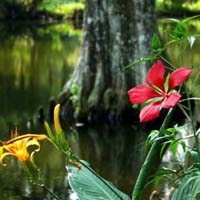
- Magnolia Plantation and Gardens, famous for its exquisite gardens dates back to 1676, when the land was settled by Thomas Drayton from Barbados. There's always something blooming in the magnificent gardens, the oldest garden in America. First planted in 1680, it was opened to the public in 1870. Hundreds of azaleas, exuberant in splendid pinks and purples, were introduced to America by the Reverend John Grimke Drayton in the mid 1800s, and over 900 varieties of camellia, in colors ranging from white to red, and in every imaginable shade of pink, bloom in glorious color. Paddle a canoe through the wildlife refuge created by the permanent flooding of old rice fields; visit the magical Audubon Swamp Garden; climb the observation tower for views of the river; visit a slave cabin; see an old rice barge.
- Drayton Hall, standing singularly on a knoll, dates back to 1738, and is as it was in colonial America. The rice plantation of the son of Thomas Drayton was only recently turned over to the National Trust for Historic Preservation by the Drayton family. While it has no gardens to stroll through, no furnishings to admire, it stands as an architectural treasure, the finest example of Georgian-Palladian architecture in America. The sole survivor of the burning of the plantations along the Ashley River by Union troops in 1865, it is relatively unchanged by the passage of time, tragedy and modernization.
- Middleton Place, the home of Henry Middleton, president of the First Continental Congress and his son, Arthur Middleton, signer of the Declaration of Independence, illustrates the enormous size and scope of the early plantations. The 65-acre formal, geometric garden terracing down to the Ashley River was planted in 1741, through 12 years of labor by over 100 slaves, and is the oldest landscaped garden in America. The first camellias in America were planted here, and three of these specimens are still alive on the plantation grounds. Re-enactments of plantation life depict the magnitude of the work carried out daily and a mouth-watering plantation lunch - corn pudding, Hoppin John, okra gumbo and she-crab soup - or dinner of quail and broiled oyster is served in the Middleton Place Restaurant, in a replica of an old rice mill.
• Visit the historic 18th and 19th century churches in the "Holy City." All are interesting, each is distinct. Some offer guided tours, others do not. If the door is open, walk inside; if not, there is plenty to admire from the outside.
Architecturally beautiful - lacy Gothic, stately, columned Greek Revival and massive Romanesque - most were built in the late 1700s and the1800s. Their founding congregations, however, date back much further as many of the original churches were rebuilt several times over following damage from fire, war and hurricanes. St. Michael's Episcopal Church, is the exception. As the oldest church structure in the city, it has remained relatively unchanged since its completion in 1761, managing somehow to survive Charleston's man-made and natural tragedies.
Founded as far back as the late 1600s by the English, French, Scots, Jews, Irish, Germans and free slaves, these historic churches provide a continuous thread to the past. In their diversity, they stand solidly for the religious tolerance which made Charles Towne unique among the colonies. The first congregation, that of St. Philips Episcopal Church, established in 1680 by the earliest English and Barbadian settlers, was followed a year later by the French Huguenot Church, the only remaining Huguenot congregation in America. First Scots Presbyterian was founded by 12 Scottish families; First Baptist Church by Baptists forced from New England by persecution by the Puritans; Emanuel A.M.E . Church by free slaves. Charleston is home to the first Catholic Church established in the colony, and is also the birthplace of Reform Judaism in America.
While you are looking, discover why the Huguenot Church was called the "Tidal Church," and the Cathedral of St. Luke and St. Paul the "Planters Church." In St. Philip's, find the pew where George Washington and Robert E. Lee both sat; admire the funerary art in the Circular Church Cemetery, the city's oldest graveyard, dating to 1696 ; learn when and why St. Michael's steeple was painted black; discover the small museum in the Beth Elohim Synagogue, the second oldest synagogue in the country.
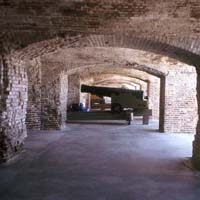
• Tour Ft. Sumter National Monument, the symbol of Southern resistance, and where the Civil War began. Accessible by boat only, fort and harbor tours depart from either Liberty Square at the corner of Calhoun and Concord in downtown Charleston, or from Patriot's Point in Mt. Pleasant.
• See regional wildlife at the South Carolina Aquarium. Experience the nature in the region without having to drive anywhere! See the wild life of the salt marsh creek - herons, terrapins, puffer fish, red-tailed hawks and owls. In the Coast Gallery, explore the great variety of sea life found in Charleston Harbor and along coastline. A slog through the boggy Blackwater Swamp at twilight is unforgettable. Interactive and great fun, spend a day there and at the restaurants and shops in Liberty Square.
• Take one of the many walking tours, each with individual appeal. Choose from one of several thematic tours from Charleston Walks: see where patriots frequented and pirates roamed, experience Charleston in the Civil War, hear the story of slavery and freedom, learn details about historic homes you might otherwise miss. The Charleston Tea Party Walking Tour ends with tea served in a private garden; Ed Grimball Walking Tours shows off Charleston as only a real local can. See the ghostly side of Charleston on a tour of the city's most haunted landmarks on one of several ghost tours.
• Take a leisurely, narrated horse-drawn carriage tour, an interesting, entertaining way to see Charleston, accompanied by the slow clip-clop cadence of a horse (or mule), properly clad in a specially designed "diaper," changed after each trip!
• Charles Towne Landing, the 663-acre state park on the site of the original 1670 settlement, is an on-going archeological unearthing project. Relive the life of early settlers in a re-creation of the early village and through interactive exhibits. The reproduction of a 17 th century trading vessel, the life-line of the plantations along the Ashley, brings home the importance of the river to the success of the colony.

Trust us, we've been there!
www.trustedtours.com